Turrigiano Lab
Homeostasis and Neural Circuit Plasticity and Function


Turrigiano Lab
Homeostasis and Neural Circuit Plasticity and Function
How can our brains be both plastic and stable?
With billions of neurons interconnected by trillions of synapses, the mammalian brain is perhaps the most complex object in the known universe - far more complex than any human-built machine. Also unlike most machines, our brains are constantly changing to adapt to a fluid environment, to store memories, and to become better at sensory perception and motor tasks. While even simple machines require mechanics to keep them tuned up and running properly, brain circuits are able to tune themselves up on the fly, so that these learning-induced changes do not destabilize circuit function. The Turrigiano lab studies identifies and studies the homeostatic plasticity mechanisms that allow our brains to achieve this remarkable trick of being both plastic and stable. Our work spans the cellular/molecular, circuit, and systems levels of analysis to illuminate how neurons and circuits adjust their own excitability to maintain stable output and preserve information flow in the face of learning and development, and how neurological disorders might arise from failures of these self-tuning processes.
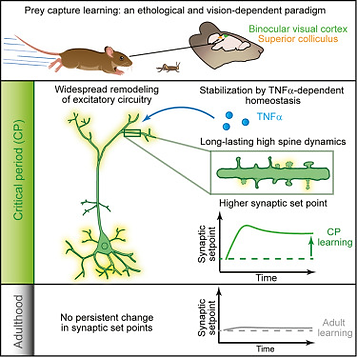
We're excited to announce that 'Ethological learning during the critical period resets synaptic setpoints in mouse binocular visual cortex' is published and available in Neuron! Read about how a vision-dependent learning task can remodel excitatory synaptic setpoints by inducing structural remodeling. This work was headed by Postdoc Diane Bissen, who would be happy to talk to anyone who wants to learn more!
Featured News Item
Latest Publication